

Dedicated to Continued Education.
Only after countless hours of education, internships, examinations, and real-world experience do we become landscape architects. The path to licensure is not always linear but that is a topic explored in a different blog. Yet even after achieving licensure, continuing education is critical to success, whether your career is just taking off or if you have seen several seasons in this profession.
The way we design, build, manage, and understand our landscapes continues to ebb and flow along with technology, environmental challenges, community need, demographic changes, and new research. We are not only naturally curious in our profession, but to maintain licensure in Michigan we are required to complete a minimum of 24 hours for every two years of practice towards our continued education. Sixteen of those hours must be on public health, safety, and welfare. These continuing education credits protect the industry and reinforce the profession’s expected level of expertise. While many people could tell you what flowers would grow and look beautiful in your garden, they may not understand how to impact erosion on a streambank that impacts water quality in the community or downstream. While you may know how to stack stone for a basic landscape edging, you may not know how to detail retaining walls so they do not fail. Continuing education can be technical, more philosophical, research based, or reviewing new technology.
OCBA regularly coordinates education credits and makes a strong effort to attend Michigan ASLA’s conference to support our landscape architects in achieving more than the minimum continuing education credits.
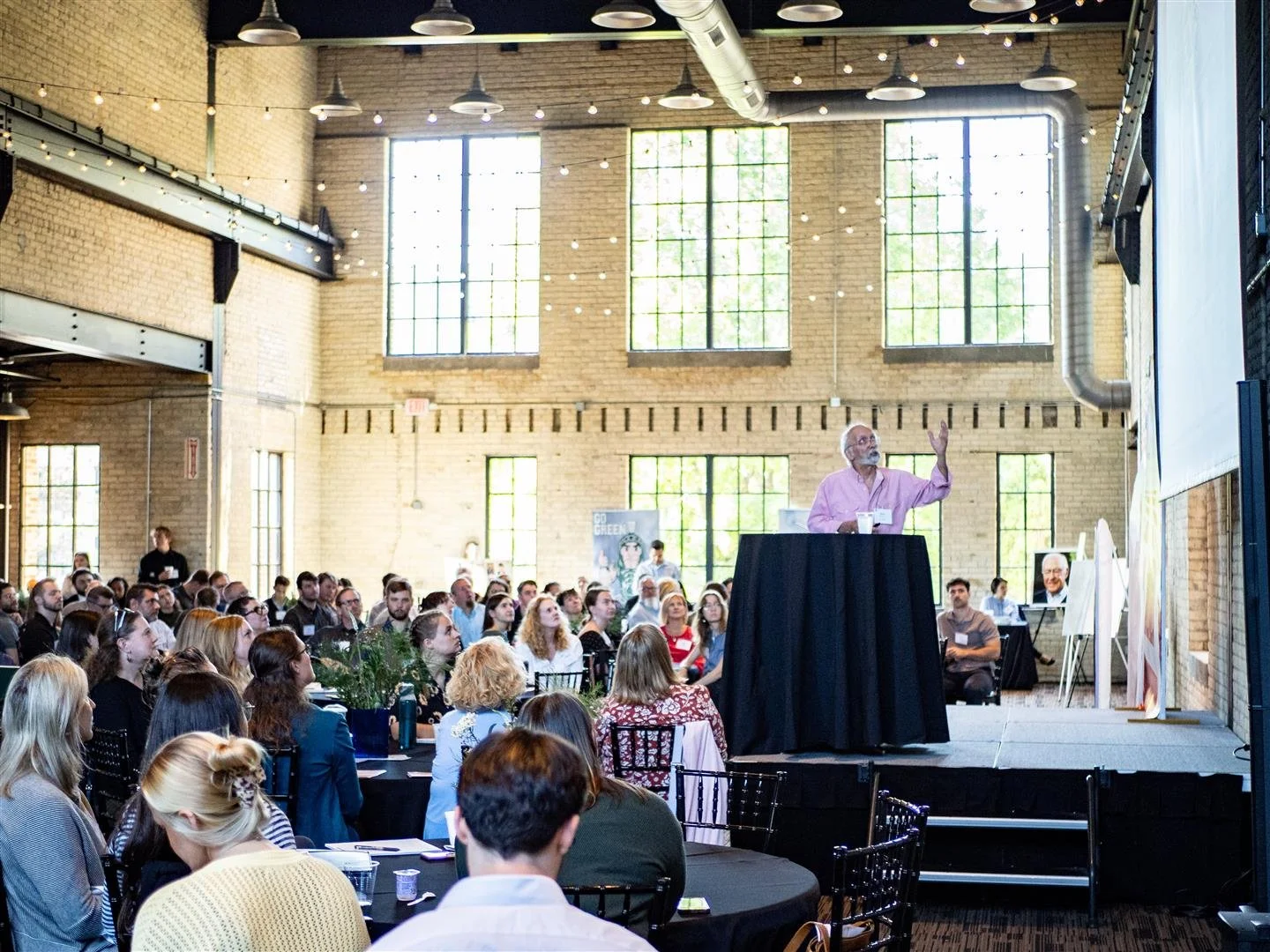
Front and center at the 2025 ASLA Conference - Grand Rapids
Keeping Up With a Changing Profession
Think about how much our profession has changed in just the last few decades.
Thirty years ago, Landscape Architecture was beginning its transition from hand-drawn graphics and traditional drafting methods toward AutoCAD and other computer-aided design software.
Today, technologies such as LiDAR and photogrammetry can help create detailed three-dimensional representations of a site before a Landscape Architect ever visits it. GIS and other data-driven tools allow us to analyze information and communicate complex studies in ways that are easier for clients and communities to understand, and also allows us to communicate or work fully remote on a project.
However, technology is only one part of the equation.
New strategies for managing stormwater, restoring brownfields, increasing climate resiliency, incorporating native landscapes, and responding to changing environmental conditions are constantly evolving in tandem with our ecosystems.
Continuing education helps us answer new questions our clients are asking with greater confidence and help us make more informed decisions that back our designs.
Separating the Fad From the Future
One of the most valuable parts of continuing education is learning to recognize the difference between something that is simply new and something that is genuinely valuable. Our industry is constantly introducing “groundbreaking” products, “state of the art” technologies, or “innovative” design approaches. Some of these will become tools that shape our work, yet others will remain claims to something they simply cannot live up to.
Continuing education allows us to explore those ideas, understand the research behind them, hear from people who are already implementing them, compare them to what we are already writing in our spec sheets and allows us to advocate for our clients with their questions/concerns in addition to our own.
Instead of simply asking, "What is everyone else doing?" we ask:
How does this solve the problem?
How does it compare to what we are already using?
How does this product perform over time with the elements in our region?
Learning From Places Beyond Our Own
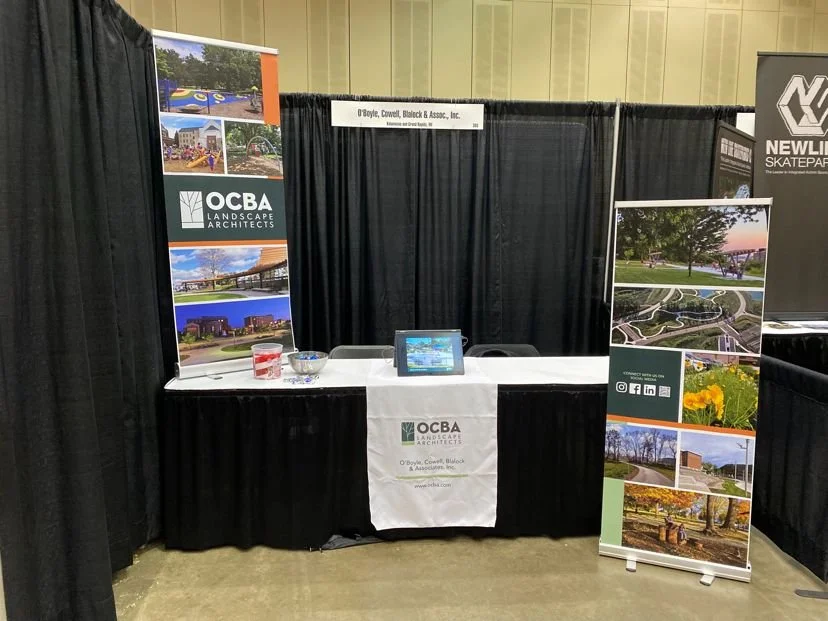
OCBA mParks Booth - March 2026
Landscape Architecture is also a profession where context matters. A strategy that works beautifully in one region may not be the right solution somewhere else. Climate, soils, ecology, culture, infrastructure, maintenance practices, and community priorities all influence how a landscape performs.
Continuing education exposes us to projects and ideas beyond our immediate surroundings. We can learn from a stormwater project in another state, a brownfield transformation across the country, a community engagement strategy from another region, or a planting approach developed for an entirely different climate.
We don't necessarily need to replicate those solutions. Instead, we can apply the lessons to our unique site or project and adapt them thoughtfully.
So, Where Will We Be in Another 30 Years?
It is difficult to imagine what Landscape Architecture will look like thirty years from now.
The tools we use today may feel as unfamiliar as hand drafting and early CAD systems do to many of us already.
Perhaps artificial intelligence, increasingly sophisticated site modeling, real-time environmental data, robotics, or technologies we haven't even imagined yet will fundamentally change how we practice.
But some things will remain.
We will still communicate with our community.
We will still understand the art of placemaking.
We will still ask the hard questions.
And we will still need landscape architects who can take an incredible amount of information and filter out the noise
.