Building a Professional Library.
Landscape architecture – and design across all industries, really – isn’t a career made in isolation. We must be trained, taught, inspired, and otherwise guided forward by our predecessors, shown not just a better choice but how to arrive there ourselves. And in this era with more interconnectivity than ever before, we have the ability and charge to create a personal library to help guide those choices.
Behind every successful landscape architect is a village working collaboratively across both years and generations to create better designs. Our field is full of those who have faced similar problems to those we face today and have solutions. Equally, it’s important for everyone, regardless of field, to look at the rest of the world for inspiration or information; from horticultural books for a planting plan or a guide on structured versus unstructured engagement for playgrounds. Through utilizing the experience and expertise of those that came before us, we both better our designs and ourselves.
Design is a field that learns from itself. Every site has context, history, interactions, community; in order to approach a design holistically, there must be a base understanding in all facets. But at the same time, we can only ask our memory for so much – filling a library to handle some of that information gives our brains enough room to create with intent and expands our capacity exponentially.
Much in the same way that a first draft is never the final draft, a personal library should be a dynamic thing that adapts as you adapt. Designers should regularly consider what gaps they have in their knowledge and seek to fill them, and while continuing education credits and registered talks are critical in their own rite, the ability to pull a book off the shelf to double check something should never be discounted.
A Few of Our Favorites:
Hortech Plant Catalog, National Audubon Society Field Guides, other plant catalogs
Anything that gives you a comprehensive list of plants; whether hunting through it for the perfect species or skimming idly between meetings, it’s never bad to familiarize yourself with the plants you work with.
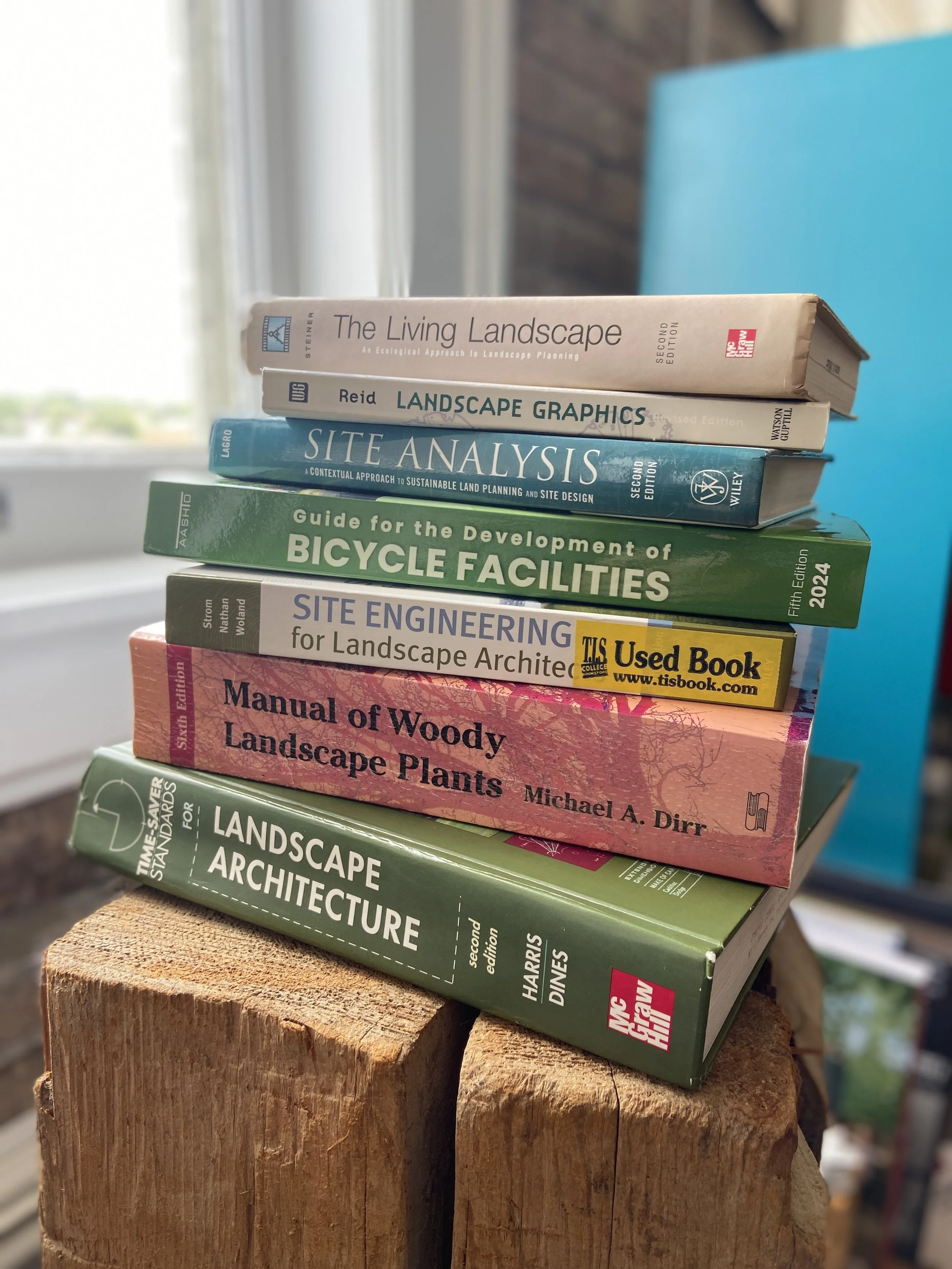
Site Engineering for Landscape Architects by Storm, Nathan, Woland
A regular reference guide for anything site engineering – one you can use frequently.
Bringing Nature Home by Doug Tallamy
An impactful start for native plant appreciation.
Unreasonable Hospitality by Will Guidara
Less landscape architecture and more industry as a whole, this provides a ‘hospitality-first’ mindset that relates well to service vs. design.
Design Inspiration
Perhaps the most fun reason is that of inspiration; sprawling pages of full-design pictures or renders that can easily whittle hours of the day away. This can span from books dedicated to park systems, vendor catalogues, a bibliography of a certain designer’s work; anything that can be stored for later use fits here. Sometimes it’s the best part of the day to go hunting for exciting ideas without a specific project in mind, and one day, you’ll thank yourself for saving that particular concept years earlier.
Research and Reference
These books tend to be the doorstoppers that look most impressive to anyone perusing your shelf, but they’re worth picking up early due to how many of them serve as indexes for the industry. From construction standards to horticulture plant identification, these books are likely to have well-worn pages riddled with notes and be pulled from their shelves frequently noted by the dog-ears put there by their users. These are also useful for larger firms; having a standard reference manual can help create more cohesive works as any company wants to adhere to their identity within the profession.
Additional Perspectives
Another underrated focus for a personal library is gaining a unique perspective. Someone trained internationally is going to provide different considerations or design choices than what you’re familiar with, helping you to look at a project with new eyes, or learning more about the inner workings of specific industries can help to better design sites intended for them. Historical architecture, new scientific studies, cultural arts, business logistics; while these might not get cracked open as often as engineering standards, they provide a well-rounded approach to our field and maybe even the unconventional answer to a design problem that begs for a non-traditional solution.